How B-Schools Make MBA Students Industry-Ready Professionals
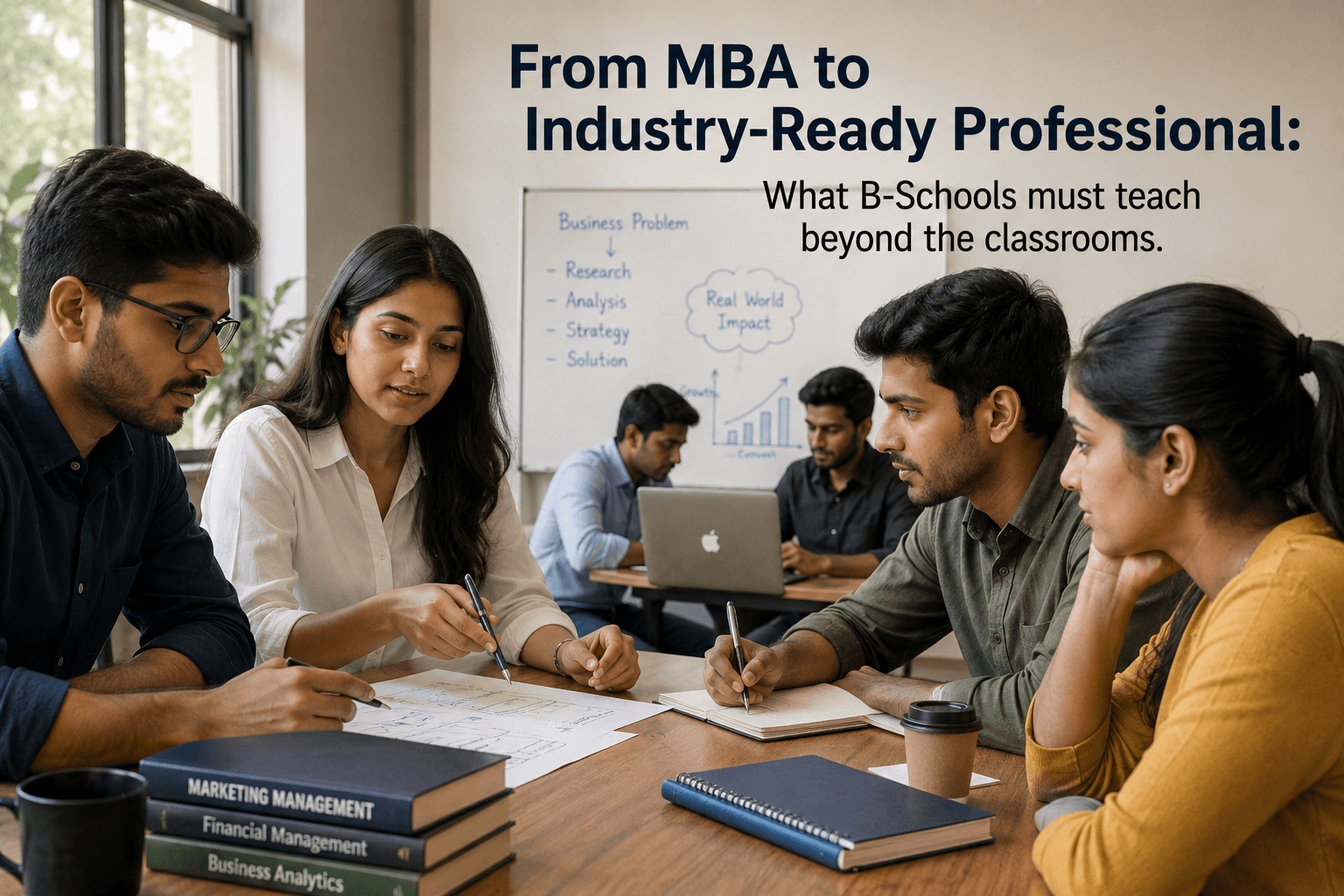
An MBA nowadays is not only just about learning management theories, attending regular classes or earning a degree. In 2026, employers need graduates who can apply those theories, knowledge, solve real-world cases, to be updated as per the trends and deliver the outcomes.
There shouldn’t be any gap between ‘’MBA graduate and industry-ready professional”, otherwise it will become a serious challenge. Therefore, many B-Schools have taken this challenge as an opportunity to improve the curriculum.
According to the recent research conducted by the World Economic Forum, it is reported that nearly 40% of worker’s core skills are expected to change by 2030, while analytical thinking remains the top core skills identified by the companies.
Read Also: Top MBA Colleges Accepting CUET PG 2026 Scores – Eligibility, Fees & Courses
1. Real world business projects, not just case studies:
B-Schools should think beyond the theoretical classroom cases. They should introduce new ways of teaching. B-schools should make students work on live projects, real business problems, and should be taught how to overcome those challenges. For example, students should be given live projects on how to improve customer satisfaction,build marketing strategies, analyse the data and identify the demands of the customer. This will help the students to understand how business works and operate. Not just by solving a case study, they should be aware of the real business problems as well.
2. AI and Business Analytics should be introduced as the compulsory subjects:
AI and Business analytics should no longer be limited to students choosing a technology related specialization. AI in Business Analytics is now the new normal so this should be taught with other specializations like human resources with business analytics or marketing with business analytics. Every specialisation is somewhere connected to technology and now technology means AI with other technologies.
For example if you choose Digital Marketing specialization you should know how technology or internet or social media works. How you can fulfill or solve the business needs using technology. Or if you choose HR specialization in this, you should have an understanding of tools like Excel, Payroll, ATS used by companies and how AI is integrated in it. So that a student learning HR is able to use the tool.
3. Internship should be included in the curriculum:
It just shouldn’t be a certificate of completion. Students should be well-aware about their role, key-responsibilities, Project, KPI and what outcomes they are supposed to deliver. Employers need some professionals who have gained some practical exposure and they have the ability to understand and apply the knowledge that they have gained during their learning period.Therefore every B-Schools should include structured internship projects into their curriculum so that a student has an experience of working on a real business problem and know how businesses or organisations operates.Students should also be asked to prepare an internship report or a presentation on what they have learned during their internship period.
Read Also: MBA Admission Predictor
4. Communication and Executive Presence
MBA is not only about just securing a good CGPA or earning a degree. It is also more about communication and executive presence. A technically strong MBA graduate can still struggle if the communication is not up to the mark or if they cannot communicate their ideas. B-Schools must train their students about Business communication, Public-speaking, Presentation skills, Negotiation skills, Client handling, Interview skills, Email and professional writing. The main objective should be to make students comfortable speaking to a client and confident while delivering information.
5. Cross-functional Knowledge:
Students should be aware about other domains also because modern business problems don’t stay inside the departmental boundaries.In today's interconnected business environment, decisions made in one function often have a direct impact on others. For example, a marketing decision can affect finance or a finance decision can affect operations. Therefore, it is important for B-Schools to encourage combinations of specializations, not just dual. This helps the students to have an excellent understanding about the business from a larger perspective rather than understanding one function of the business.
6. Entrepreneurship and Ownership mindset:
B-schools should emphasise on inculcating Entrepreneurship and Ownership mindset into the student.Students who don’t want to become entrepreneurs can still benefit from entrepreneurial thinking. They should learn how to identify the opportunities, validate an idea, understand customers, their needs and demand, build a business model, pitch an idea and learn from failures. The goal of the B-Schools should be to develop problem owners, not just job seekers.
Read Also:All IIM Placement Report 2026: Average & Highest Package of All IIMs
7. Industrial visits and tours:
B-schools should not wait for the students to begin with their internships to have an industry exposure. Industry interaction should be an integral part of management education throughout the MBA journey, rather than something that happens only during the placement season. They should conduct some industrial visits and tours more often.B-Schools can bring professionals into the curriculum though such as guest sessions, mentorship, live projects, corporate challenges, pre-placements projects. This will help the students to understand what companies actually expect from an entry level of managers.
8. Career readiness as part of the curriculum:
Placement preparation should begin in the first semester itself only not two months before the graduation or placement drives. Students should be taught to build their Resumes, LinkedIn profiles, Professional portfolios, Interview skills, Personal branding, Networking skills and they should be aware about the dress code that it should be strictly formal rather than informal looks. Their overlooked personality should be groomed. The degree will open the doors to many opportunities but their demonstrable skills and presentation skills will get them selected.
B-Schools are the future of Students.
The Traditional model looks like:
→ Classrooms + Exams + Placements = Degree
The Industrial model should look more like:
→ Classrooms + Industry + Technology + Analytics + Projects + Communication + Leadership + Internship = Industry- Ready Professional.
Eventually the question B-Schools should ask is not that:
“Have we taught the students everything in the syllabus?’’
They should ask themselves that:
‘’Are the students ready to walk into the corporate world tomorrow and solve a real business problem?’’
The value of an MBA therefore lies not only in what students learn in the classroom, but also in how effectively they can apply that knowledge in the real business world.
Read More:
Frequently Asked Questions
1. How do B-schools prepare MBA students for the industry?
Ans. B-schools prepare students through internships, live projects, case studies, industry interactions, and practical management training.
2. Why is industry exposure important for MBA students?
Ans. Industry exposure helps students understand real business challenges, develop practical skills, and prepare for workplace responsibilities.