UPI Revolution in India: From Cash to QR Codes & Digital Payments
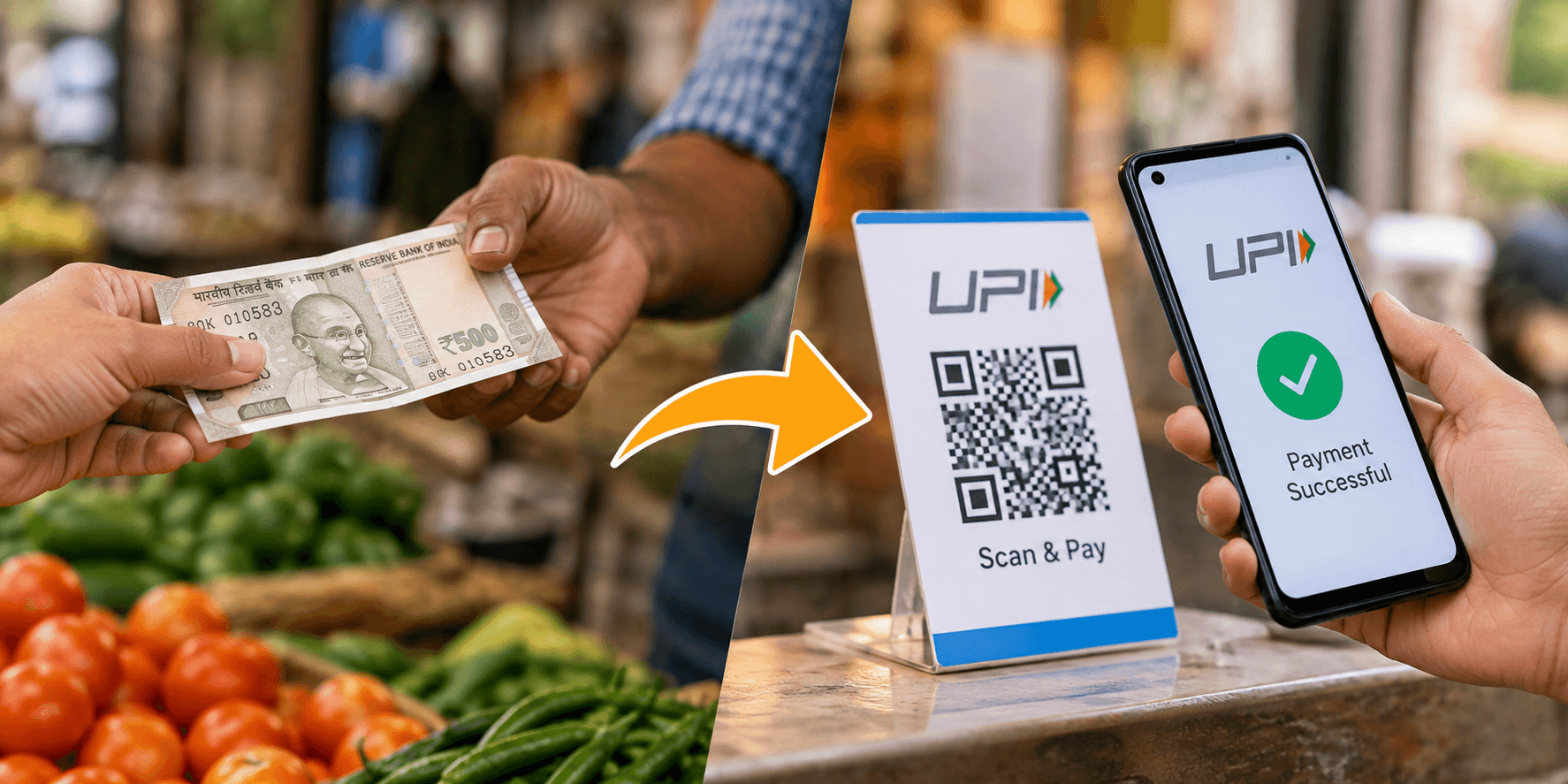
The payment system in India has seen tremendous evolution over the past decade. For decades, carrying cash had been the most popular way to make almost all kinds of payments from vegetable purchases at the local market to settling an invoice at a restaurant.
Nowadays, having a smartphone with a QR code may be enough to make a payment instantly.
At the heart of the payment revolution in India lies the Unified Payments Interface (UPI). UPI has revolutionized not only the payment process itself but also how people think of money and shopping in general.
The transition from money to QR codes is among the most significant shifts in India's digital economy.
What is UPI?
UPI stands for Unified Payments Interface. It is also called UPI, which is the instant digital payment system created by NPCI (National Payments Corporation of India).
UPI was introduced as a pilot project on April 11, 2016, by NPCI under the regulatory control of RBI and became operational to serve customers in August 2016.
UPI allows the transfer of money between accounts through the application installed in the user's phone. The user does not have to use cash or specify long information about bank accounts for every transaction; he can use such things as UPI ID and QR codes.
The convenience of UPI was one of the main reasons for its popularity.
A client needs only to scan the QR code of the merchant, type the sum, confirm the transaction and pay.
See: How to Start an E-Commerce Business in India 2026-27: Complete Guide
Cash Prior to UPI: Dominance of Paper Money in Routine Transactions
In the era before online money transfers, paper money was an essential part of the Indian economy.
The Dawn of the UPI Revolution
UPI was rolled out in 2016 to give people an infrastructure for digital bank-to-bank payments.
UPI gained popularity with the growth of smartphone usage and availability of cheap internet access in India.
Various payment apps played a major role in getting UPI to millions of consumers and traders and making it more understandable and accessible.
Probably one of the major innovations in terms of UPI acceptance was using QR codes.
Rather than setting up expensive card readers, the trader could just put up a QR code that customers would pay from their mobile phones.
Consumers would generally carry paper currency while buying goods or services, dining out, traveling, etc. Small businesses also found cash more comfortable to deal with as it was readily available.
Online banking was present; however, it may not have been convenient for small ticket transactions.
There were credit/debit cards, especially in organized retail, but their usage required infrastructure like PoS terminals.
Cash remained the easiest way to pay for millions of small merchants.
The game changed with the advent of UPI.
UPI: 2016 to 2026
| Indicators | 2016 | 2026 | |
| Status of UPI | Pilot launch | Mature national payment infrastructure | |
| Number of banks | 21 on launch | 741 banks live as of July 2026 | |
| Volume of transactions per year | 1.78 crore transactions for FY 2016 - 17 | 24,162+crore for FY 2025-26 | |
| Value of transactions per year | ₹0.07 lakh crore | Around ₹314 lakh crore | |
| Scale of Monthly Transactions | Below 1 lakh initially | 2,450.90 crore in August 2026 | |
| Value of Monthly Transactions | Very small initial value | ₹29.82 lakh crore in August 2026 |
As per the NPCI's latest monthly data, in August 2026, UPI processed 24,508.96 million transactions, which is equal to 2,450.90 crore transactions, with a total value of ₹29,82,355.95 crore, i.e., approximately ₹29.82 lakh crore. The number of banks living on UPI was 752 as per August 2026.
Also read: Top Indian CEOs with MBA Degree | What Is The Scope Of PGDM?
From Wallets to Bank-to-Bank Payments
In pre-UPI times, digital payments were mostly related to the use of either cards, online banking, or digital wallets.
Through digital wallets, people had access to digital money that they could use to make payments.
However, UPI offered an alternative way, allowing consumers to make account-to-account transfers using a common platform.
Consumers could therefore make payments using any UPI app while accessing their respective bank accounts.
QR Codes Transformed the Ground-Level Economy
Possibly the most obvious representation of the UPI transformation is the QR code. Go to a market in India now and you will find the QR code virtually everywhere.
A shop owner might have a QR code on the cash counter. A food seller might have one on his tiny board. Even a taxi driver could accept payments digitally using a QR code.
There has been a huge behavioral change.Before, the buyer had to have money in hand. Now, all that is required of the buyer could be a phone and a bank account.
The QR code has essentially transformed regular businesses into digital transaction centers.
Why Was There Such Quick Acceptance Of UPI By Indians?
There were several reasons for the quick acceptance of UPI by the people.
1. Ease
The ease of transferring money through banks was taken away by UPI.It has been made quite simple for regular people.
2. Speed
Most transactions are done within seconds as long as all the banks and networks work well.
3. Accessibility
UPI operates through smartphones and associated bank accounts and thus helps digital payments extend their scope beyond that of card-based payments systems.
4. Low Infrastructure Barrier for Merchants
QR codes may often prove easier to implement than card-based payment infrastructure.
5. Widespread Usage of Smartphones
Increased usage of smartphones and the internet laid the groundwork for digital payments.
6. Changing Expectations of Consumers
After consumers got used to making quick payments digitally, convenience became a significant consideration for selecting the mode of payment.
Read Also: List of All IIM Placement: Average & Highest Package 2026
UPI and the Small Businessman
One of the most important impacts of UPI has been on small businesses.
Previously, if a small businessman was to use card payments, he needed to have a POS terminal and an appropriate banking system for card transactions.Through QR-based UPI payments, things can become much simpler.For a small retailer, it allows him to sell even if the customer does not have any cash with them.
For a consumer, it enables him to transact through digital mode even when card transactions are not possible at all.
This has contributed towards bridging the gap between the formal and informal payment systems in India.
How UPI Transformed the Behaviours of Consumers
It is not just another mode of payment that UPI introduced, but also changed the ways of paying.Just take a look at your daily routine.
One can pay for his or her breakfast, make purchases, pay a taxi driver, order lunch, make online purchases, divide the bill with friends, and make monthly payments using UPI.
Most of those payments were done using cash or card previously.
Now, one’s smartphone works as the means of payment that people always keep with themselves.
From “Do You Take Cards?” to “UPI Hai?”
One of the best ways to show this behavioral change is through everyday dialogues.
Previously, consumers used to ask,“Do you take cards?”
Nowadays, in many Indian markets, one finds people asking,“UPI hai?”
This small change signifies the bigger change in the behavior of consumers.
Acceptance of digital payments has become an integral part of many companies’ business
Role of UPI in Financial Inclusion
The significance of UPI goes beyond convenience.
Digital payments can also facilitate financial inclusion through linking the transactions made by individuals on a daily basis with the banking system.
For those who already have a bank account and a smartphone, the use of UPI will allow for convenient electronic transfer of money.
Even small-scale merchants can engage in e-commerce without necessarily having an advanced payment mechanism in place.
Impact on E-commerce
The UPI system has also contributed to the expansion of e-commerce.
More and more e-shopping, food delivery, travel, entertainment, subscription, and other digital services are now integrating the UPI payment gateway.As a consumer, it provides an alternative to cards and cash on delivery.
From the perspective of a business, digital payment systems might help ease the process of transactions.
In this way, the expansion of the UPI system goes hand in hand with the overall digital transformation in India.
Major UPI Apps in India
As a result of the open and interoperable nature of the UPI platform, there have been several apps associated with the system.
Some of the most popular UPI apps include:
PhonePe
Google Pay
Paytm
BHIM
The statistics of the NPCI ecosystem highlight the significant contribution of these apps. For instance, in August 2025, PhonePe had 9,152.54 million transactions of UPI, Google Pay had 7,063.76 million transactions, and Paytm had 1,407.23 million. BHIM is another app used for accessing the UPI system.
It is vital to note that these apps are only the interface for accessing UPI while UPI is the payment platform itself.
Check: Best Places in the World to Study for an MBA | MBA Admission Predictor
UPI and the Changing Nature of Cash
It would not be appropriate to argue that cash has become extinct in India.Cash continues to be important for a variety of consumers, businesses, and transactions.But what has changed is the nature of cash.
Earlier, cash used to be the go-to payment instrument. Now, consumers have more options.
A consumer might choose to carry some cash and transact via UPI in other cases. A different consumer could use cards for certain transactions and UPI for small transactions.
What has changed is the shift of India from being a predominantly cash economy to a multi-channel payment ecosystem where digital payments play an important part.
Challenges of the UPI Revolution
The fast expansion of digital payment systems brings with it a set of new challenges as well.
Cybersecurity
Fraud related to digital payments, phishing, spoofed payment requests, social engineering attacks are significant issues.
One must never disclose UPI PINs, OTPs, and passwords related to banking details.
Digital Literacy
Every user may not have equal knowledge regarding digital finance. There needs to be consumer awareness regarding safe payment practices.
Internet and Technological Challenges
The process relies on smartphones, telecommunications networks, banking, and payment technologies. Technology issues may temporarily hinder transactions.
Responsible Consumption
Online payments are very convenient, but convenience may lead to overspending. Consumers should keep track of their spending and maintain responsible budgets.
The Future of UPI in India
The UPI revolution is far from over yet.
As the Indian digital economy grows, it is probable that payment mechanisms will become more and more integrated into shopping, transport, finance, business, and many other facets of life.
The future is not going to only entail making payments faster; it would also include ensuring better security, accessibility, reliability, financial literacy, and protection of consumers.
Innovations relating to digital payments could also provide new prospects for businesses and FinTech firms.
UPI offers an excellent example to students and future managers of the effects of technology on consumer behavior.
UPI and the Expansion of Indian Payments Internationally
The story of UPI does not end in India anymore.
Through NPCI International Payments Limited, UPI has been expanding internationally in cooperation with international partners.
Currently, UPI can be accepted or operated in the following international markets:
Singapore
United Arab Emirates
France
Nepal
Bhutan
Sri Lanka
Mauritius
Qatar
As per the government information in 2026, there are 11 countries where UPI operates.
Conclusion - From Cash to QR Codes
The history of UPI is essentially the history of behavioral changes.
India has transitioned from being a country that relied heavily on the use of physical cash to becoming a country where a smartphone could be used to make payments to businesses in shops, eateries, markets, websites, and many other places.
The lowly QR code has become a representation of this change.
In going from cash counting to code scanning, from carrying cash to having phones, India has made significant behavioral changes to its payment habits.
UPI has thus become an integral part of everyday life in India and has helped bring about a digital revolution in the country.
The UPI revolution has thus gone beyond just technological changes.
Read More:
- Tier 1 vs Tier 2 MBA Colleges in India 2026: Fees & Placements
- MBA Placements 2026-27: Hiring Trends, Top Recruiters & Salary Packages
- How to Get Admission into IIMs: CAT Percentile & Admission Process
Reference:
Frequently Asked Questions
Q1. When was UPI launched?
Ans. It started as a pilot on April 11, 2016, and went live for customers in August 2016.
Q2. How many transactions does UPI handle?
Ans. In September 2026, UPI processed 24.07 billion transactions worth ₹29.37 lakh crore, up 23% in volume year-on-year.
Q3. Is UPI free to use?
Ans. P2P transfers are free. P2M payments up to ₹2,000 carry zero MDR, while a 0.4% MDR applies to specified P2M transactions above ₹2,000. MDR is charged to merchants, not to regular users.
Q4. What is UPI?
Ans. UPI (Unified Payments Interface) is NPCI’s instant payment system that lets you send money between bank accounts using a UPI ID, mobile number or QR code.
Q5. Is UPI safe?
Ans. Yes, if you stay alert. Never share your UPI PIN or OTP, and remember you enter the PIN only to send money, never to receive it.