Market Segmentation: Meaning, Importance, Types & STP Marketing Model
In today’s dynamic market environment, it cannot be assumed that one product or marketing message can be equally appealing for everyone. There is a difference in the needs, preference, purchasing behaviors, lifestyles, and budgets of the customers. This is the reason why it is important for the companies or businesses to understand their target customers and their needs. This is the reason where market segmentation plays a vital role.
Let’s first understand, what is market segmentation, and why is it considered one of the important concepts of marketing?
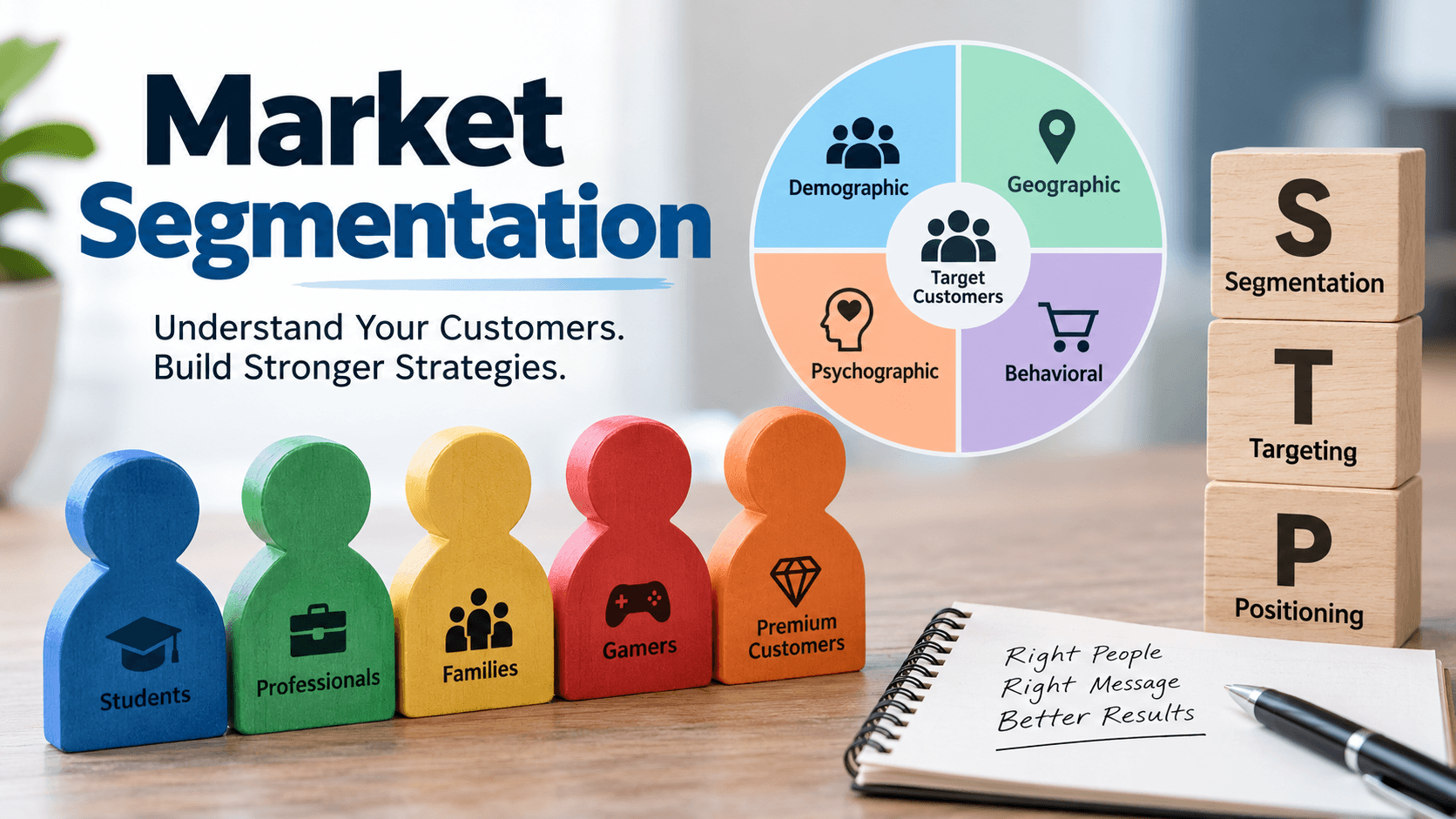
Market segmentation is basically a process where a broad market is divided into smaller groups of customers who have the same characteristics, needs or behaviors. By analysing and identifying the customer’s needs and preference, businesses may develop similar products, attractive marketing campaigns to promote their products, pricing strategies and customer satisfaction.
Market segmentation is an integral part of the STP marketing framework includes:
→Segmentation
→Targeting, and
→Positioning
This framework helps businesses decide whom to serve and how to position their offerings.
For example, consider a company selling laptops. Its potential customers could include:
→Students looking for affordable laptops.
→Professionals who need productivity features
→Companies looking for their employees
→Gamers looking for high-performance devices
→Premium customers looking for luxury and advanced features
Although all these customers are buying laptops, their priorities are different.
A company who can understand the customer’s behaviour and preferences of buying will be able to create products which satisfies the customers.
For PGDM students, learning about marketing segmentation is important to position the product in the market, to maintain customer relationships, develop the product and make marketing strategies.
Read Also: Career Options After an MBA in Marketing
Why is Marketing Segmentation important ?
Marketing Segmentation is important for every business because it helps them to understand the customers in a better way and deliver what they expect.
1. It helps to understand the customer’s needs:
Every individual has different needs and preferences so to understand everyone’s needs and preferences becomes difficult but segmentation makes it easier to understand. Segmentation divides the broader market into smaller segments according to their needs and wants. It allows businesses to identify these differences and understand what motivates each customer group
For example, a premium clothing brand may target customers who prioritize high-quality ingredients and are willing to pay more, while another brand may focus on customers looking for affordable everyday clothes. .
2. Enables more targeted marketing:
Instead of sending the same marketing messages to everyone, businesses can create more campaigns which are directed towards a specific target.
For example, a smartphone brand may target:
→College students who are looking for affordable options.
→Professionals who want the best camera quality
→Premium customers looking for advanced technologies
3. Improves customers satisfaction:
Companies get better responses from the customers when they understand their needs well. Segmentation enables companies to segregate the groups of customers and provide them with the relevant offers, recommendations and information according to their tastes, preferences, choices and needs.
For example, an online shopping platform can recommend products based on a customer's previous purchases, browsing behavior and promote the products accordingly.
This creates more customer satisfaction. .
4. Helps businesses use marketing budgets effectively:
Segmentation helps to analyse from where they can generate more values from the market. Because of the segmentation, it helps the businesses to minimise the budgets and improves the cost effectiveness. It allows the companies to identify the customers and allocate the budget accordingly.
Instead of spending the whole budget on the broader market it is important to first analyse the targeted customers, divide them into segments and prioritize segments that align with their objectives.
5. Supports product development:
Segmentation can also help to develop the product on the basis of understanding the customers. Because when businesses understand their customer’s choice, preferences, and problems faced by different segments, they can analyze, identify the opportunities for new products and can improve the product.
For example a company which sells chocolates can identify that there is a growing demand for a healthy lifestyle among the newer generation so they prefer chocolates which contain less sugar, calories and provide more energy content.
Read Also: How Neuromarketing is Revolutionizing Advertising Strategies?
Types of Marketing Segmentation:
There are four types of Marketing Segmentation. Following are the types of marketing Segmentation:
- Demographic Segmentation
- Behavioral Segmentation
- Geographic Segmentation
- Psychographic Segmentation.
- Demographic Segmentation:
Demographic Segmentation divides the market according to the measurable characteristics.
There are some common factors which include:
→Age
→Gender
→Income
→Occupation
→Education
→Family Size
→Marital Status
For example, a clothing brand may offer different products to kids, teenagers, adults, and old age people. Demographic segmentation helps to make products according to an individual’s needs and wants.
1. Geographic Segmentation:
Geographic segmentation segregates the customers according to their location or place.
There are some factors that includes:
→Country
→State
→City
→Region
→Urban or rural areas
→Climate
For example an air conditioner brand may promote their AC more heavily in hotter regions or focus more in the summer season rather than in winters. Similarly a heater brand would focus more in the winter season rather than in summers.
Geographic Segmentation is specifically useful for the companies whose products or customer preference depends upon the location.
2. Psychographic Segmentation:
Psychographic Segmentation focuses on the psychology or characteristics of the customers.
There are some major factors involved such as:
→Lifestyle
→Personality
→Values
→Interests
→Attitudes
→Opinions
This type of segmentation helps to understand the buying habits of the customers.
For example, there are two customers and both have the same income but still one chooses to buy a high priced product and other buys a cheaper product. So there is a difference in the lifestyle, one may prefer to buy luxurious brands and one may prioritize to buy sustainable products
3. Behavioral Segmentation: .
Behavioral Segmentation focuses more on the behavior of the customers towards a product or brand.
Companies may analyze:
→Purchase frequency
→Brand loyalty
→Product usage
→Benefits sought
→Purchase occasions
→Response to promotions
→Browsing and engagement behavior
For example an online shopping website might categorize customers as first-time buyers, frequent buyers, inactive customers or suggest something according to their previous purchases. Also according to the occasions some clothing brands may focus more on promoting traditional clothes in the market.
Read Also:- Impact of Movies on Youth - Trending GD Topic for MBA
Market Segmentation and STP Model:
Market Segmentation is interconnected with the STP marketing model:
Market
↓
Segmentation
↓
Targeting
↓
Positioning
This framework helps companies to develop a focused marketing strategy rather than trying to appeal to everyone or promoting the products in the broader market.
1. Segmentation:
Segmentation focuses on “Who are the different customer groups?”. Businesses divide the broader market into different segments according to their needs and wants.
2. Targeting:
Targeting focuses on “Which customers should we focus primarily on?”. Businesses analyse their target customers and choose one or more groups to serve.
3. Positioning:
Positioning focuses on “How do we want the customers to perceive our brand?’’. Businesses develop unique selling propositions to attract the customers that differentiate it from the competitors.
Read More:
- Impact of Globalization on the Indian Economy
- How to Start an E-Commerce Business in India 2026-27: Complete Guide
FAQs: Market Segmentation, Types, Importance & STP Model
1. What is market segmentation?
Ans. Market segmentation is the process of dividing a broad market into smaller groups based on similar needs, interests, or characteristics.
2. What are the 4 types of market segmentation?
Ans. The four main types are demographic, geographic, psychographic, and behavioral segmentation.
3. Why is market segmentation important?
Ans. It helps businesses understand customers, create targeted marketing campaigns, improve customer satisfaction, and increase sales.
4. What is the STP model in marketing?
Ans. The STP model stands for Segmentation, Targeting, and Positioning. It helps businesses identify and reach the right customers.
5. What is demographic segmentation?
Ans. Demographic segmentation divides customers based on age, gender, income, education, occupation, and other demographic factors.
6. What is the difference between market segmentation and targeting?
Ans. Segmentation divides the market into groups, while targeting involves selecting the most suitable group to serve.
7. How does the STP model help businesses?
Ans. The STP model helps businesses focus on the right audience, differentiate their products, and develop effective marketing strategies.