India Economy 2026: Growth, Challenges, Opportunities & Future
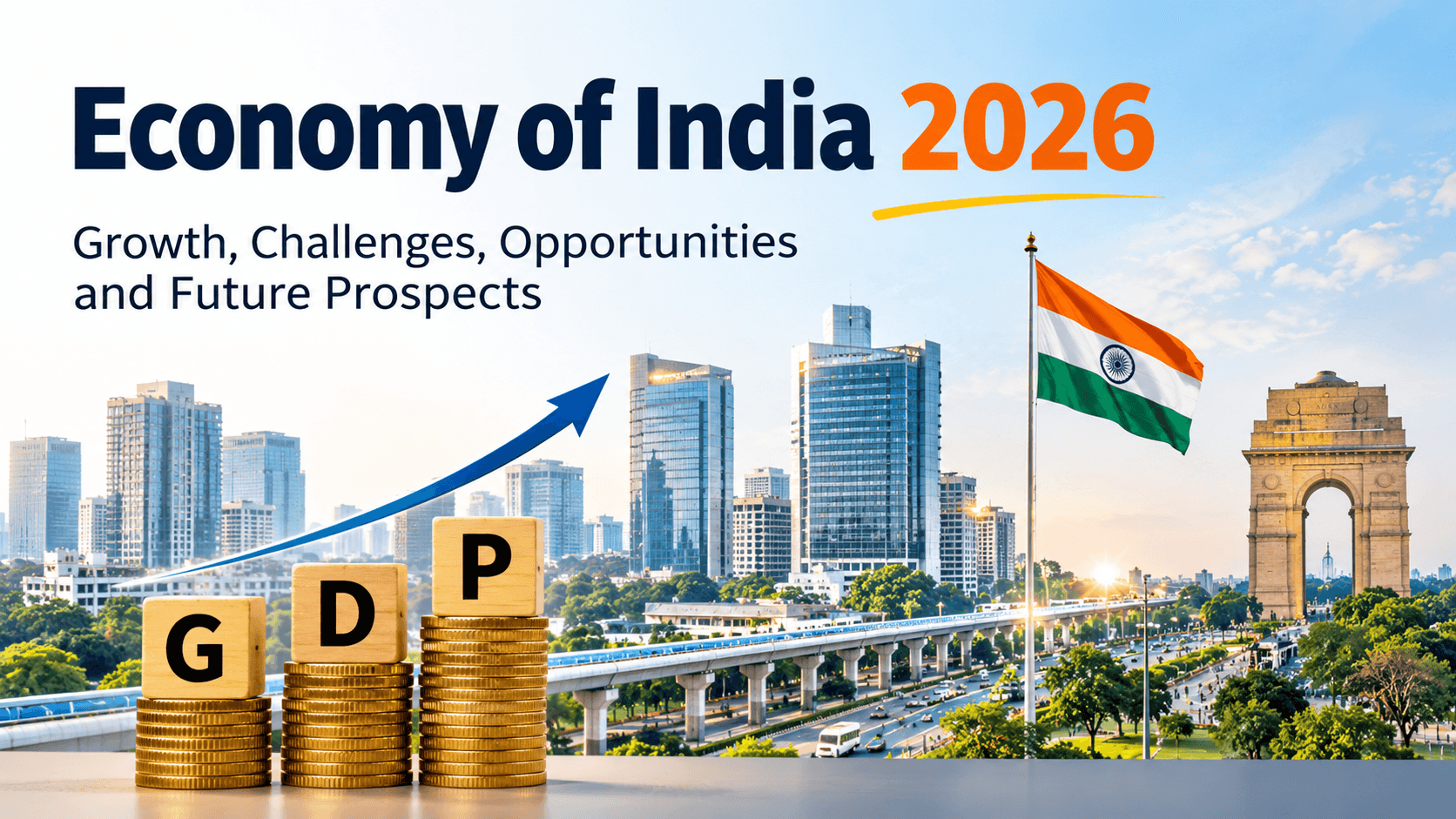
The Indian economy is one of the most vibrant and dynamic economies in the world. In the last few decades, the Indian economy has witnessed tremendous economic development where the economy has shifted from being primarily agrarian to more diversified where the economy has become service, manufacturing, tech-driven.
India has become an important player in the world of economics because of the huge consumer base, young demography, emergence of the middle class, development in digital infrastructure, and increased international business. Government policies such as Make in India, Digital India, Startup India, and PLI have also played an important role in the economic development of the country.
In 2026, India has continued to perform economically despite many global challenges like geopolitical tensions, uncertain international business, high energy cost, and disrupted supply chains.
On the other hand, economic growth is not confined to GDP alone. Generation of employment, equality of income distribution, alleviation of poverty, education, health care facilities, infrastructure, and sustainable development all matter.
This Blog is a journey through India's economy, economic growth, sectors, initiatives, prospects, and much more.
Read More: Top 50 Business Schools in India placement wise 2026
1. Indian Economy: An Overview
The Indian economy is a mixed economy as both the public and private sectors are involved in economic activities. The Indian economy consists of agriculture, manufacturing, industries, services, trade, banking, technology and other economic activities.
India is one of the largest economies in the world and also one of the fastest growing economies. Economic power of India results due to its domestic consumption, investments, exports, entrepreneurship and labor force.
A few major factors in the Indian economy are as follows -
- Big domestic market - India’s sizable population constitutes substantial demand.
- Young labor force - A big proportion of the young labor force allows growth chances.
- Service industry - IT, banking, finance, consulting, tourism and telecom sectors make up a considerable share of GDP.
- Developing manufacturing industries - Electronics, automobile, pharma, textile and engineering among the other industries.
- Technological shift - UPI system, banking, e-commerce and digital public infrastructure have altered the business landscape.
- Infrastructure development - Development of highways, railways, airports, ports and urban infrastructure is taking place.
The economy of India is also aided by the rising startup environment and participation in foreign trade.
2. Economic Growth of India in 2026
The economic growth of India has been steady even in the face of uncertainty in the global economy.
As per the Ministry of Statistics and Programme Implementation (MoSPI), the GDP of India increased by 7.7% in FY 2025-26 from 7.1% in FY 2024-25. The provisional GDP of FY 2025-26 was approximately ₹323.12 lakh crore at constant prices.
Furthermore, the economic performance of India was quite promising during the first quarter of the fiscal year 2026-27.
| India’s most recent GDP figures |
| 7.7% | GDP growth, Fiscal Year 2025-26 | 7.8% | GDP growth, Q1 FY 2026-27 |
| ₹323.12 lakh cr | Real GDP, Fiscal Year 2025-26 | ₹81.36 lakh cr | Real GDP, Q1 FY 2026-27 |
Source: MoSPI provisional GDP estimates and Q1 FY27 estimates
India's GDP growth rate was forecasted to be 6.6% for the fiscal year 2026-27 as per the World Bank's India Development Update released in April 2026.
The robust performance of Q1 shows that the economy is being sustained by domestic demand, manufacturing, and services. However, forecasts may vary with changes in the international environment.
Read Also: UPI Revolution in India: From Cash to QR Codes & Digital Payments
3. The Major Sectors Fueling India's Economy
The economy of India can be broadly classified into three sectors; primary, secondary and tertiary. All three sectors have significance in terms of employment, production and income generation.
A. AgricultureSector
One of the oldest and most significant sectors in the Indian economy is agriculture. Agriculture is a source of employment and income for many people of India as well as providing food security and rural development.
India is one of the largest producers of rice, wheat, milk, pulses, spices, fruits, and vegetables in the world.
Contributions of agriculture in the Indian economy -
- Employment to millions of farmers.
- Source of raw material for industries such as textile, sugar and food processing.
- Facilitates rural consumption and development.
- Makes a contribution to the agricultural exports of India.
- Ensures food security.
Challenges faced by farmers - Unpredictable rain, climatic changes, small land holding, lack of proper storage facility, increase in input cost, fluctuation in prices.
Some government schemes such as PM-KISAN, Pradhan Mantri Fasal Bima Yojana, agriculture infrastructure development and e-NAM help farmers increase their income and agriculture productivity.
B. Industrial and Manufacturing Sector
The industrial sector plays an essential role in the economic growth of India through production, employment creation and promoting exports.
Some key sectors include -
- Cars and electric vehicles
- Pharmaceuticals and medical products
- Steel and cement production
- Textile and clothing industry
- Semiconductors electronics manufacturing
- Engineering goods and chemicals
- Food processing
India is aiming to become a manufacturing destination for the world. Programs like Make in India and Production linked Incentive scheme promote manufacturing in India.
There is huge scope for the manufacturing sector to cut down dependency on foreign products and also promote exports.
C. Services Sector
The services sector constitutes the biggest contributor to the GDP of India and includes those sectors that deliver services rather than any product.
Major sectors in the services industry include -
- IT and software
- Banking and finance
- Insurance
- Tourism and hospitality
- Education and healthcare
- Telecommunication
- E-commerce and digital marketing
- Consultancy
India has emerged as an IT and business process outsourcing hub, offering software services and consultancy services.
As per Economic Survey 2025-26, the services export from India grew to record USD 387.6 billion in fiscal year 2024-25, marking a growth of 13.6%.
Growth and rise in IT firms, startups, fintech firms and digital platforms will further drive this sector ahead.
See: Tier 1 vs Tier 2 MBA Colleges in India 2026: Fees & Placements
4. Major Factors Driving Indian Economic Growth
There are several internal and external factors that are leading to the growth of the Indian economy.
1. Increased domestic consumption
India has a large population, which has high purchasing power. There is an increased demand for automobiles, smart phones, residential homes, consumer goods, healthcare, and education, leading to the increased operation of businesses.
2. Infrastructure developments
Development of infrastructure has become critical for long term economic growth. This includes the development of roads, railways, airports, metro transport, logistics parks, and seaports.
3. Digital revolution
The growth of India’s digital economy is substantial. This is seen from UPI, internet banking, Aadhaar based services, digital payment and e-commerce sectors.
4. Foreign direct investments (FDIs)
With foreign investments, there is increased capital flow, technology sharing, job creation and international business opportunities.
5. Growth of Start-ups and Entrepreneurship
India has a strong start-up ecosystem where businesses are created in fintech, edtech, healthtech, artificial intelligence, logistics and e-commerce sectors.
6. Government policies
Reforms and policy initiatives in the form of tax reform, GST, digital government, infrastructure development and favorable policies have led to improvements in the business environment.
Check out: Impact of Privatization on Indian Economy 2026 | Top Indian CEOs in the World 2026
5. Importance of Government Policies in India’s Economic Growth
Various schemes and programs have been rolled out by the Government of India for economic development, attracting investments and generating jobs.
| Program | Primary Objective | |
| Make in India | Economic development through domestic manufacturing | |
| Digital India | Economic development through digital services and infrastructure | |
| Startup India | Economic development through entrepreneurship | |
| Skill India | Economic development through improved skills among the workforce | |
| PM Gati Shakti | Economic development through improved infrastructure planning and connectivity | |
| Production Linked Incentive Scheme (PLI) | Economic development through domestic production | |
| Pradhan Mantri Mudra Yojana | Economic development through small businesses and entrepreneurship | |
| Atmanirbhar Bharat | Economic development through domestic capacities | |
| Smart Cities Mission | Economic development through urban development initiatives | |
| PM-KISAN | Financial assistance to selected farmers |
Through these initiatives, the economic fabric of India is being strengthened through improved productivity, investment and job generation.
However, the effectiveness of such programs depends upon their successful implementation and transparency.
See: How to Start an E-Commerce Business in India 2026-27: Complete Guide
6. International trade and exports of India
International trade is a significant aspect of India's economic growth. India exports a variety of goods and services to many countries around the world.
Some of the main Indian exports are -
- Petroleum products
- Pharmaceuticals
- Engineering goods
- Gems and jewelry
- Textiles and garments
- Chemicals
- Rice and agricultural goods
- Software and IT services
- Business and professional services
Total exports in India amounted to a record of USD 825.3 billion in FY 2024-25, according to the Economic Survey 2025-26.
India takes advantage of international trade agreements, foreign investments, and demand for technology and professional services.
At the same time, some of the problems faced by India include international trade barriers, international competition, high logistics costs, exchange rate risks, and dependency on crude oil and certain electronics imports.
7. Important Issues in the Economy of India
However, despite strong growth of its economy, there are various problems which remain in India. Overcoming them is vital for ensuring sustainable and equitable development.
1. Unemployment and Employment Generation
Unemployment is one of the biggest economic problems in India, especially among the youth.
Millions of students join the labor force every year after completing their college and university degrees. But the number of available jobs does not always coincide with the growth in the labor force.
The other problem is underemployment, wherein individuals have jobs that do not match their level of education or experience.
Possible solutions -
- Skill-based education and vocational training.
- Entrepreneurship and startups.
- Growth in manufacturing and labor-intensive sectors.
- Collaboration between industry and academia.
- Increase in formal employment.
2. Income Inequality
Economic development does not help all individuals in equal proportion. There is a marked variation in the levels of incomes, wealth, and opportunities amongst various groups within society.
Individuals residing in urban areas generally have greater access to job opportunities, education, health services, and business opportunities than those living in faraway rural areas.
The reduction of income inequality needs policies which are inclusive, quality education, healthcare, social security, and jobs.
3. Inflation and Increasing Cost of Living
Inflation is defined as an increase in the price level of goods and services.
Increase in the price level of food, fuel, transport, housing, and other necessities has an impact on household expenditure, particularly for middle and lower class households.
Increase in inflation also leads to increase in production cost of firms.
The government and the Reserve Bank of India (RBI) employ fiscal and monetary measures to control inflation.
See: CAT 2026 vs XAT 2027: Exam Pattern, Syllabus & Preparation
4. Agricultural Challenges
There still exist many challenges in the agricultural sector, such as -
- Reliance on monsoon rains.
- Fragmented land holdings.
- Lack of technological advancements.
- Poor cold storage facilities.
- Variable prices in the market.
- Climate change threats
This sector can be improved by focusing on irrigation, agricultural research, digital agriculture, and food processing.
5. Infrastructure and Urbanization
India has been doing well in terms of building up its infrastructure, but much more can be done in transport facilities, inexpensive housing, waste disposal and management, sanitation, water, and many more things related to the infrastructure.
Urbanization also adds to the challenges. In the wake of this trend, traffic pollution, waste management, and housing are big challenges.
6. Uncertainty in Global Economy
India is connected to the global economy through trade, investments, technology, and finance.
Conflicts around the globe, world recession, trade barriers, and problems in the supply chain may affect the exports, cost of energy, and foreign investments of India.
For instance, the rise in international crude oil prices can affect India’s import cost and inflation levels.
8. The Influence of Technology and Digitization on the Indian Economy
Technology has emerged as one of the key catalysts for economic transformation in India.
Some of the developments made possible by technology are -
- UPI - Facilitates digital payments and facilitates cashless transactions.
- Artificial Intelligence (AI) - Enhances automation, data analysis, customer service and productivity.
- E-commerce - Enables businesses to make their products available to customers digitally throughout India.
- Fintech - Increases the reach of digital banking and loans.
- Cloud computing - Assists in the management of digital operations.
- EdTech - Ensures digital learning and professional education.
This has created job opportunities in data analysis, cybersecurity, software engineering, digital marketing, artificial intelligence, and fintech.
On the contrary, there has been an urgent need for dealing with issues related to automation, cybersecurity, digital divide, and reskilling.
9. Opportunities in the Indian Economy
The Indian economy presents great business opportunities for both internal and external companies due to its vast marketplace, increasing number of consumers, technological infrastructure, and increased production capacities.
Among those sectors which hold great potential for business are -
| Sector | Possible opportunities |
| Artificial Intelligence | Automation, AI services and analytics |
| Renewable Energy | Solar, wind, and green hydrogen energy |
| Electric Vehicles | Manufacturing of electric vehicles and their accessories |
| Healthcare | Hospitals, equipment and pharmaceuticals |
| Education | EdTech services, professional education |
| Tourism | Hotels, travel services, culture |
| Manufacturing | Electronics, automotive industry products |
| FinTech | Digital banking, payments services |
| E-commerce | Online stores and logistics sector |
| Infrastructure | Transport networks, urban development |
Check out: MBA in Business Analytics 2027: Colleges, Fees, Salary & Scope
These sectors have much potential to attract investments and create jobs.
10. Future of the Indian Economy: Growth Prospects and Expectations
There are positive prospects for the future economy of India owing to innovations in technology, infrastructure development, manufacturing and consumption.
India has also defined its vision of becoming a developed country by 2047 under the initiative of Viksit Bharat 2047.
Major sectors that could define India's economic future include -
1. Expansion in manufacturing: India plans to consolidate its status as a manufacturing powerhouse in the world, specifically in electronics, automobile industry, semiconductor industry, pharmaceuticals and defense production.
2. Artificial Intelligence and Technology: AI, automation, robotics, and data analytics will revolutionize the industrial sector and increase efficiency in business.
3. Green Economy: Renewables, electric vehicles, and sustainable infrastructure will be key factors in the future development of India.
4. Infrastructure Development: Building new roads, rail lines, airports, ports, and smart cities will improve connectivity and economic activities.
5. Expansion of the Middle Class: As people earn more money and spend more, there will be more need for housing, education, healthcare, financial services, and consumer goods.
6. International trade: There would be increasing international trade partnerships and export competitiveness of India in the world.
GDP Growth Outlook of India for FY 2026-27
Various international organizations have made different forecasts for the economic
| Institution | Growth projection of GDP |
| World Bank (April 2026) | 6.6% |
| OECD (June 2026) | 6.3% |
| Economic Survey 2025-26 (January 2026) | 6.8%-7.2% |
See: Role of RBI in Indian Economy: Functions, Importance and Impact
All these figures are based on various assumptions and were released at various time periods. All these figures indicate the uncertainties related to international trade, energy prices and geopolitics.
However, India's huge internal market, financial stability and increased industrial capacity give India a solid base for further economic growth.
11. How Can India Become a Developed Country by 2047?
Becoming a developed country by 2047 is not only about having a high GDP growth rate; it is about improving the standards of life of its citizens, their productivity, employment and access to basic services.
Some of the most important considerations are -
1. Education - Improving the quality of education and providing skills to students which are relevant to industry.
2. Healthcare - Increasing availability of affordable healthcare facilities, hospitals and other medical infrastructure.
3. Employment - Providing employment in manufacturing, technology, agriculture and service industries.
4. Empowerment of women - Providing equal opportunities to women in terms of employment and entrepreneurship.
5. Rural development – Development of road networks, power supply, irrigation, education, and health care in rural regions.
6. Research and development – Investment in scientific research and development of new technologies and products.
7. Sustainable development – Promotion of renewable energy sources and sustainable industrial development.
8. Ease of doing business – Improvement in the regulatory environment and investments.
The World Bank has also emphasized the need for private sector driven growth, better business environment and investment in infrastructure, manufacturing, healthcare and energy.
12. Effect of the Indian Economy on Students and Job Opportunities
Growth in the economy not only helps in creating opportunities for organizations but also creates job opportunities for students.
As new industries grow, organizations look for skilled individuals who are familiar with technology, finance, management and communication.
Some of the career options that one may consider are -
- Business Analytics and Data Science
- Finance and Investment Banking
- Marketing and Digital Marketing
- Human Resource Management
- Supply Chain and Operations Management
- Artificial Intelligence and Machine Learning
- Entrepreneurship and Business Development
- International Business
- Banking and Financial Services
Students taking up MBA and PGDM courses will gain from learning about economic trends, market situations, consumer behavior and business policies.
For instance, growth in manufacturing means that organizations will need professionals in operations, logistics, supply chain and finance. In the same way, growth in digital industries means there is more demand for marketing professionals, data analysts and technology managers.
Thus, knowledge of the Indian economy becomes essential for students who wish to have a successful career in management, business and entrepreneurship.
Conclusion
The Indian economy has undergone considerable change and is emerging as a major player in the world economy. Domestic consumption, infrastructure, digitalization, manufacturing growth, and services industry growth have been driving the economic development of the country.
But issues such as unemployment, income inequality, inflation, agriculture, skills, and environment require constant attention.
The true measure of economic development of India will lie in the fact that whether the economic growth leads to better job opportunities, improved standards of living, quality education, affordable health care, and equal opportunities for everyone in society.
With the correct policies, human resource development, technological innovations, and sustainable development, India can emerge as a developed country by 2047.
Read More: