Skill-Based Hiring vs Degree-Based Hiring: What Employers Prefer in 2026
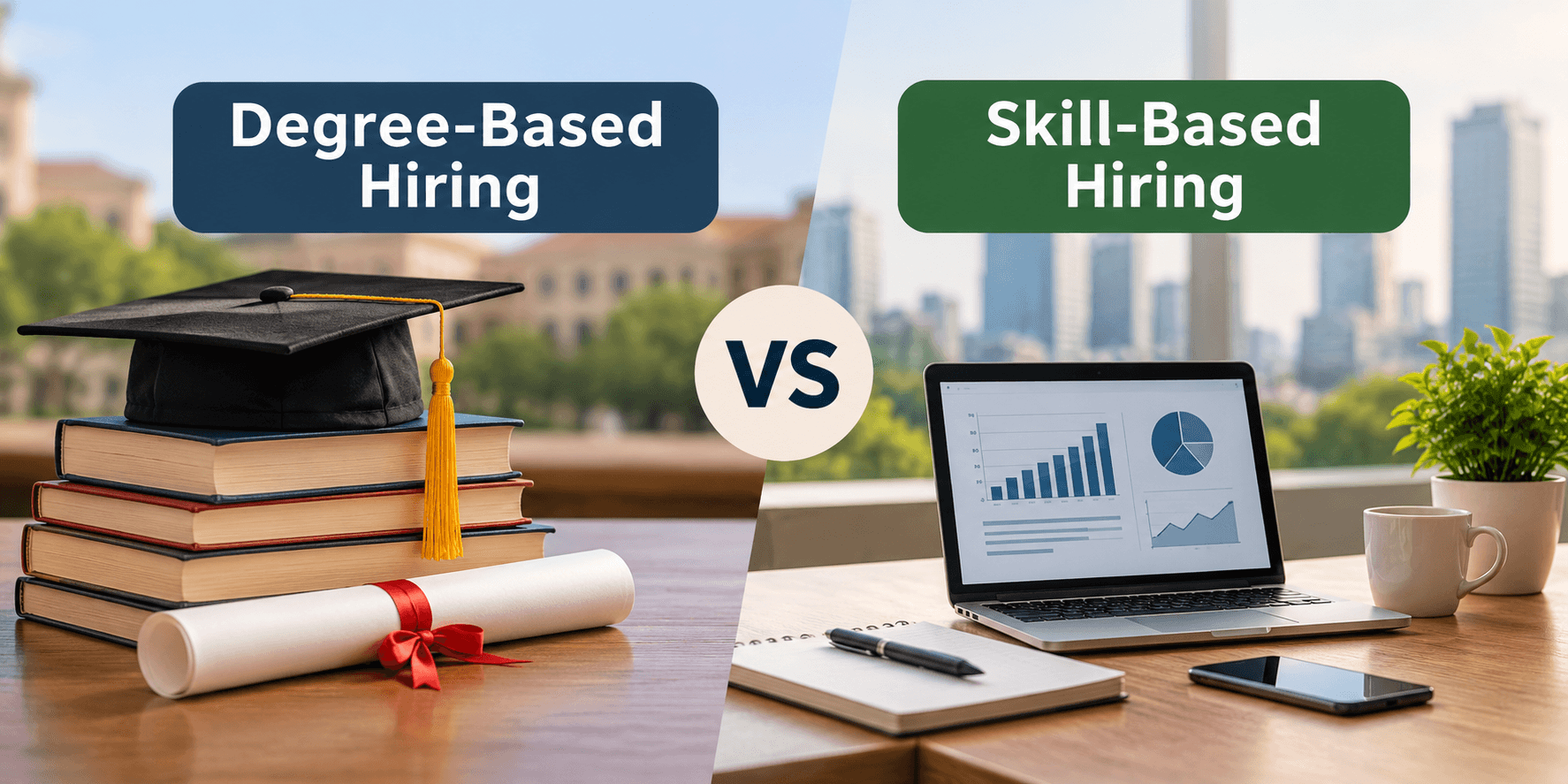
One of the requirements for getting a job used to be a university degree for many years. The university degree was the simplest criteria that helped employers select candidates, particularly for the positions where professionalism, management, and business atmosphere were needed. Nevertheless, the labor market is changing rapidly due to digitalization, artificial intelligence, automation, and new business models.This situation causes demand for new skills, which might not be reflected in the conventional degree.
There is an urgent question for employers, students, and job seekers – should companies hire candidates with degrees or with real skills?
It does not mean that employers should choose one criterion and ignore another one because a degree helps gain academic knowledge and discipline, and skill shows what you are able to do.
In accordance with the Future of Jobs Report 2025 by the World Economic Forum, employers believe that 81% will be relying on work experience as a way to evaluate candidates from 2025 through 2030, whereas 48% will be evaluating the skills of those candidates. The degrees that people earn at universities are still considered important, as 43% of employers plan to utilize them when hiring people.
Read Also: List of All IIM Placement: Average & Highest Package 2026
What is Degree Based Recruitment?
Degree based recruitment is the process wherein the employer takes into account the educational qualification of the candidate as one of the crucial criteria for employment.
For instance, a company may require that the candidate be having:
- MBA for the post of Manager
- B.Tech for Engineer
- CA for some accounting posts
- Law degree for Legal post
- Bachelors Degree for Entry Level Corporate Post
The degree serves as the first filter. There could be hundreds or thousands of applications received by recruiters.
Benefits of Degree-Based Recruitment
There are many advantages that a degree may have.
1. Robust theoretical background
Formal education provides students with an environment of theories and conceptual studies. For instance, in case of an MBA/PGDM, students get introduced to marketing, finance, human resource management, operations, and business strategy.
2. Prestige associated with a profession
Some of the careers that need qualification include doctors, lawyers, engineers and accountants.
3. Structure of education
Curriculum in most cases is well structured in degrees. Assignments, tests, projects and presentations provide discipline and knowledge basics.
4. Recruitment on campus
Most companies recruit employees straight from colleges and universities. It gives an opportunity to students to get into internships and placements in the corporate world.
However, it does not mean that someone who has a degree must have all the skills required for the job.
What is Skill-based Hiring?
The approach in skill-based hiring emphasizes what the candidate can do over the educational qualifications that the candidate holds.
In addition to the question, “what degree does this candidate hold?” there could be other questions asked such as -
- Can the candidate solve problems?
- Can they analyze data?
- Can they communicate?
- Can they operate relevant software?
- Can they manage a project?
- Can they work with customers?
- Can they show relevant experience through projects or internships?
Skills may also be demonstrated through work experience, internship, certification, portfolio, testing, competitions, freelancing, and practical exercises.
For example, when recruiting a candidate for digital marketing, the employer looks into the candidate's skills to create a campaign, analyze data, content creation, and use of advertising platforms other than his educational background.
Read More: MBA in India: Career Scope, Opportunities & How to Get into Top MBA Colleges
Why Is Skills-Based Hiring Increasing?
The advancement in technology is far more rapid than any education system can always adapt its curriculum.
According to The Future of Jobs Report 2025 of the World Economic Forum, it is predicted that around 39 percent of skills possessed by the current workforce will become either outdated or obsolete from 2025 to 2030.
It also highlights some of the rapidly growing areas in terms of skills including AI and big data, networks and cybersecurity and technological literacy.
Thus, organizations need candidates that have the capability to adapt.
In India, this trend holds particular relevance. According to the report by the World Economic Forum, 67% of firms in India feel that there is a need to leverage diverse pools of talent compared to 47% globally. It is also noted that 30% of firms in India believe that not having a requirement for degrees and relying on skills-based hiring would be an efficient talent acquisition strategy compared to 19% globally.
Skill-Based Recruitment vs Degree-Based Recruitment
Both recruiting methods emphasize different indicators of candidates’ abilities.
| Factor | Degree-Based Recruitment | Skill-Based Recruitment | |
| Indicator of ability | Educational credential | Competency | |
| Indicator assessment process | Academic degree, college, academics | Skill test, projects, expertise | |
| Evidence of learning | Achievements of the educational program | Experience gained through practice | |
| Talent pool | Potentially smaller | Potentially larger | |
| Routes of entry | Education institutions | Possible many | |
| Appropriate for | Jobs that have specific credentials needed | Jobs that can be evaluated practically | |
| Candidate development | More likely educational process | Continuous learning process | |
| Main disadvantage | The degree does not correspond to present skills | Measuring skills objectively is difficult |
It is clear from the table above that both recruiting techniques have their pros and cons.
Do Degrees Matter Anymore?
Yes. The emergence of skills-based hiring does not necessarily imply that degrees are no longer important.
There are professions where a degree is needed because it provides some important base. Also, there are professions which require certain qualifications due to professional, legal or technical reasons.
A degree also means that the person has completed an extensive training programme. It might show that one has been exposed to academic knowledge, research, collaboration, and structured problem solving.
The data from the 2025 World Economic Forum only supports this view – even though employers are increasingly interested in hiring based on experience and skills, 43% of them will still be using a university degree as a hiring criteria until 2030.
Hence, the debate should not be necessarily about "degrees vs skills". It should rather be about degrees and skills.
Reason for Practical Skills Becoming more Valuable
Companies need employees who add value to company goals in the end.
The candidate might be well qualified, but will still require extensive training before becoming productive. Alternatively, the candidate may be less qualified in educational terms but has high levels of practical skills.
For instance, let us take the example of companies recruiting a data analyst. An educational qualification might show that the individual has gone through an education in that field, but the employer will also want to know if he/she can:
- Work on Excel
- Work with SQL
- Data visualization
- Business data analysis
- Dashboards building
- Provide information to management
In addition, an MBA or PGDM student may learn all about marketing theories, but the employers will also look for skills like conducting market research, customer behaviour analysis, digital marketing, preparation of presentations, client communication skills.
This is why projects, internships and industry experience have become highly valuable for employability purposes.
Also read: Top Indian CEOs with MBA Degree
The Role of AI in Skills-Based Recruitment
The growing influence of artificial intelligence is increasing the significance of skills debate further.
AI is revolutionizing the way employees are completing their work in marketing, finance, human resources, IT, operations and other industries. Instead of performing the tasks manually, the employees will have to collaborate with AI-based tools in the future.
The World Economic Forum states that apart from creative thinking, resilience, flexibility, agility, and leadership, some of the human qualities, there are many emerging skill areas including AI and big data.
Hence, there is an important point that apart from requiring employees who are knowledgeable in current technologies, employers need to hire employees who can learn new technologies in case of any changes.
Thus, adaptability is gaining importance along with the ability to learn continuously.
Implications for MBA and PGDM Students
The evolving nature of recruitment provides a chance for business students to acquire a blend of theoretical knowledge and practical skills.
An MBA or PGDM student can improve his/her employability through -
1. Communication Skills
Effective communication skills are essential for presentation, interviews, group work, selling, leading, and client interactions.
2. Data and Analytical Skills
Understanding the basics of Excel, business analytics, dashboards, and data analysis could assist management graduates in working efficiently with business data.
3. Digital Skills
Students may consider learning digital marketing, social media analytics, CRM systems, artificial intelligence and other digital tools related to their specialization.
4. Industry Exposure
Through internships, practical projects, and corporate interaction, students will gain insight into how theoretical knowledge gets applied in actual business settings.
5. Problem-Solving
A problem-solving skill may come in handy for a candidate that is capable of understanding the problem and analysing its potential solutions.
6. Adaptability
Adaptability to learn new technologies and business environments might become a great asset in one's career development.
What Should Employers Do?
For firms, shifting towards skills-based hiring is not synonymous with removing the requirement of degrees from all job listings.
On the contrary, employers can ascertain the qualifications that are necessary for each position.
For instance,
The position may demand a degree -
If a job requires a legal certification of professionalism.
The position may require skills -
If a job position involves content creation, digital marketing, sales support, UI/UX designing or even certain tech positions where practical skills can be demonstrated.
Firms can also opt for assessment tests, work samples, case studies, internship and practical interviews.
This would enable recruiters to go beyond the prejudices of education.
see: Most Common MBA Interview Questions Asked in Personal Interview
Future: Hybrid Hiring Approach
In the future, recruitment may be neither entirely based on degrees nor entirely on skills.
A hybrid approach to hiring may be more common.
Such an approach involves:
Education + Skills + Experience + Potential
A degree gives the basic knowledge. Skills show competence in applying it. Experience highlights how a person has used his/her skills. And potential reveals whether the person is capable of learning further in the future.
It may also assist students in realizing that education is only part of career planning.
Conclusion
Skill-based hiring vs. degree-based hiring is part of a larger evolution of the labor market.
Degrees still have their importance in that they give organized education, essential knowledge and required qualifications for certain professions. On the other hand, employers look for skills, experience, flexibility and the application of knowledge.
Nowadays' trends indicate that degrees are gradually substituted but will not be completely replaced. The Future of Jobs Report 2025 by the World Economic Forum demonstrates that while university degrees will be used as one of the indicators of hiring, employers will pay much attention to work experience and assessment of skills.
For jobseekers and students, the bottom line is clear – getting a degree needs to go together with acquiring relevant skills.
In the modern labor market, the best profile might not necessarily be that of the individual with the highest level of qualification and those with the most numerous skills.
It may well be a profile of the person who combines education with experience, communication, technology skills, problem-solving and continuous learning.
As technology transforms the workplace, the capacity to learn continuously becomes as significant as the acquired knowledge of candidates.
Check:
- Best Places in the World to Study for an MBA
- Impact of Movies on Youth - Trending GD Topic for MBA
- MBA Admission Predictor
FAQs: Skill-Based Hiring vs Degree-Based Hiring
1. What is skill-based hiring?
Ans. Skill-based hiring focuses on a candidate’s practical skills, abilities, and experience rather than formal degrees.
2. What is degree-based hiring?
Ans. Degree-based hiring prioritizes educational qualifications and academic credentials when selecting candidates.