MAH CET MBA Syllabus 2026: Exam Pattern & Topics
Primary Keyword: syllabus of mah cet
MAH CET MBA Syllabus 2026: Exam Pattern & Topics
The MAH MBA CET (Maharashtra Common Entrance Test) is an important entrance exam if you are planning to pursue your MBA from Maharashtra. It is conducted by the State Common Entrance Test Cell of the state. Pass outs from this examination gain admission in top colleges, such as JBIMS, SIMSREE, Welingkar, and PUMBA. This MBA entrance Maharashtra examination evaluates candidates on analytical, logical, verbal, and mathematical skills Understanding the syllabus of MAH CET for MBA is the most crucial step to scoring well. Along with the syllabus, having clarity about the MAH CET exam pattern helps you structure your preparation effectively. Let’s look at this blog to know more:
Why is understanding the Syllabus of MAH CET MBA Important?
A clear understanding of the syllabus helps you prioritize high-scoring and high-weightage areas. It allows you to create a focused and structured study plan instead of preparing randomly. By aligning your preparation strictly with the official syllabus, you improve time management, increase accuracy, and elevate overall performance. But before you get started, it is essential to have a rough overview of the exam pattern that you would have to answer in the paper.
Exam Pattern of MAH MBA CET
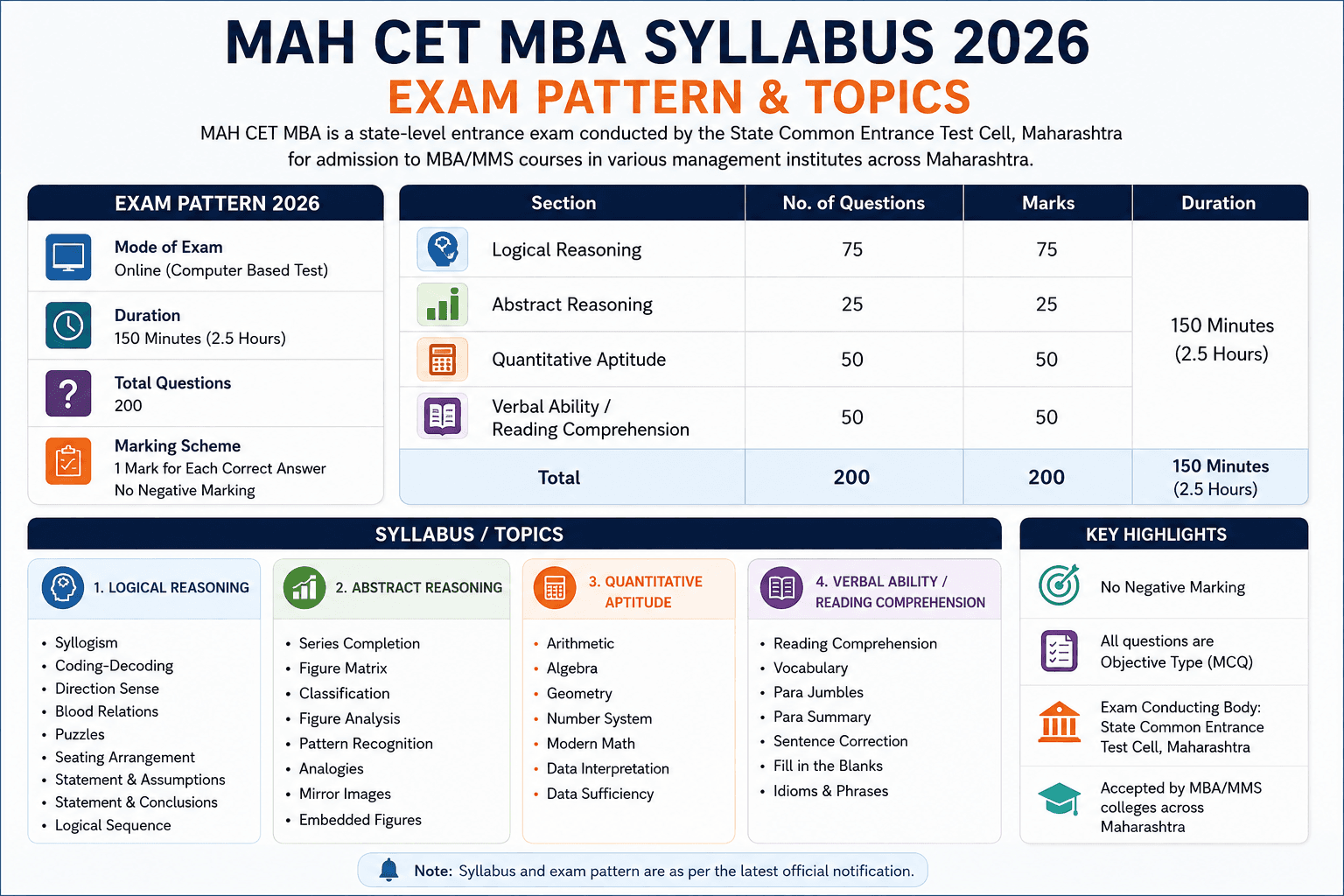
As per the MAH CET exam pattern set by the government of Maharashtra, the paper is divided into four sections, including Abstract Reasoning, Logical Reasoning, Quantitative Aptitude and the Verbal and Reading ability section. There are a total of 200 questions distributed across four sections that need to be attempted within 150 minutes. The best part of this examination is that there will be no negative marking and section time limits. Students have the freedom to switch between sections and attempt the questions in any way that is convenient to them.
| Aspect | Information | |||
| Entrance Exam | MAH MBA CET | |||
| Conducting Authority | State Common Entrance Test Cell, Maharashtra | |||
| Total Questions | 200 | |||
| Question Format | MCQ’S | |||
| Test Duration | 150 Minutes (2.5 hours) | |||
| Section-wise Breakdown | · Logical Reasoning: 75 questions | · Abstract Reasoning: 25 questions | · Quantitative Ability: 50 questions | · Verbal Ability & Reading Comprehension: 50 questions |
| Scoring Pattern (2024) | · +1 mark per correct answer | · No negative marking |
Keep in mind:
- Each correct answer would award you with 1 mark, and there will be no deduction for an incorrect answer.
- To score well, attempt as many questions as possible to improve the overall score.
Revised Syllabus of MAH CET MBA
After a thorough understanding of the exam pattern, the next step is to know about the syllabus that you would need to study for the exam. Let’s understand each section of the MAH CET MBA examination in detail, along with the important topics:
| Section | Description | Important Topics | ||||||||||||||
| Logical Reasoning | The logical reasoning section tests the analytical thinking, pattern identification and logical problem solving skills of the candidate. It is considered as the most scoring section if you are familiar with the concepts. | · Seating Arrangement (Linear/Circular) | · Blood Relations | · Coding-Decoding | · Direction Sense | · Syllogism | · Input-Output | · Data Sufficiency | · Series & Pattern Recognition | · Statement & Assumption | · Statement & Conclusion | · Cause & Effect | · Puzzles | · Analogy | · Ranking & Ordering | |
| Abstract Reasoning | This is the visual section in the examination that tests the observation skills of the candidate. This gives the examiner a hint of how attentive a candidate can be and their capability in terms of speed and accuracy. | · Pattern Completion | · Series of Images | · Mirror & Water Images | · Figure Analogy | · Odd Figure Identification | · Embedded Figures | · Symbol-Based Reasoning | · Visual Classification | · Sequence & Series | ||||||
| Quantitative Aptitude | This is a moderately difficult section in the paper. It focuses on examining your math skills, calculation speed and conceptual clarity. | · Arithmetic: Percentage, Profit & Loss, Ratio & Proportion, Simple/Compound Interest, Time-Speed-Distance, Time & Work, Average, Mixtures & Alligations | · Algebra: Linear/Quadratic Equations, Inequalities. | · Geometry & Mensuration: Triangles, Circles, Coordinate Geometry, Area & Volume | · Modern Math: Permutation/Combination, Probability, Set Theory | · Data Interpretation: Bar Graphs, Pie Charts, Line Graphs, Tables, Caselets | ||||||||||
| Verbal Ability & Reading Comprehension | This section tests the English proficiency, vocabulary and grammar and comprehension skills of the candidate. (Interpretation and inference) | · Verbal Ability: Synonyms/Antonyms, Vocabulary Usage, Sentence Completion, Para Jumbles, Error Detection, Fill in Blanks, Grammar Rules, Idioms & Phrases | · Reading Comprehension: Business/Economy, Social Issues, Technology, Current Affairs, GK-Based Passages |
Chapterwise Division of the Paper
It is essential for the candidate to know about the weightage of the questions in detail. Here is an organised table that shows the chapter-wise weightage for all four sections of the paper. Students can take reference from it at the time of their preparation. This will let you know which chapter questions have the highest priority and which ones are the lowest. Plan accordingly for good results.
Section A- Logical Reasoning (Chapter wise Weightage)
| Topic | Estimated Qs (Range) | Weightage (%) |
| Seating/Puzzles | 25–30 | 35 |
| Coding-Decoding | 10–12 | 15 |
| Syllogisms | 7–10 | 10 |
| Series | 7–10 | 10 |
| Blood Relations | 7–8 | 10 |
| Critical Reasoning | 4–8 | 7 |
| Other Reasoning | 6–10 | 13 |
Prioritise seating/ puzzles and master the coding and decoding questions along with the series as they have appeared the most times in the exam paper.
Section B- Abstract Reasoning (Chapter wise Weightage)
| Subtopic | Typical Qs | Weightage (%) |
| Series/Analogy | 10 | 40 |
| Pattern Matching | 5 | 20 |
| Image Analysis | 5 | 20 |
| Miscellaneous | 5 | 20 |
Focus on pattern recognition and practice with timers to avpid over thinking. It will help you to score well in this section.
Section C- Quantitative Aptitude (Chapter wise weightage)
| Topic | Est. Qs (Range) | Weightage (%) |
| Arithmetic (Percentages, Profit-Loss, Ratio, Time-Work, SI/CI, Averages, Mixtures) | 15–20 | 35 |
| Algebra (Equations, Progressions, Logarithms) | 8–10 | 20 |
| Geometry & Mensuration | 6–8 | 15 |
| Data Interpretation (Pie, Tables, Graphs, Sufficiency) | 8–12 | 20 |
| Probability, Set Theory, Misc. | 3–5 | 10 |
In case quantitative, focus on the arithmetic basics (TSD, Work, Profit and Loss) to score high. Be selective on d/geometry and revise formulas and tables quickly.
Section D- Verbal & Reading Comprehension (Chapterwise weightage)
| Topic | Est. Qs (Range) | Weightage (%) |
| Reading Comprehension | 18–22 | 40 |
| Vocabulary (Synonyms, Antonyms, Cloze, Idioms) | 10–14 | 25 |
| Grammar & Error Spotting | 7–10 | 15 |
| Para-jumbles/Arrangement | 7–10 | 15 |
| Other (Sentence completion, correction) | 2–3 | 5 |
Read a lot to prepare for this section and get to know as many synonyms, antonyms, idiom as you can. As much as you will read stuff, the more would be acquainted with words and passages.
Preparation Strategies to Study the Syllabus of MAH CET for MBA
Now you need to know about strategies that could help you score well. As these entrance exams are highly competitive, cracking the scores might be difficult. However, if you follow a well-planned preparation strategy, things can get easier. Let's look at a few to ace your examination this year:
- Begin your preparation by analyzing the syllabus and exam structure of the MAH MBA CET entrance exam.
- Start studying early so that you can be familiar with your strong and weak areas. This will give you a clear idea of where you need to work on more.
- If your logical reasoning section is weak, make sure to practice the puzzle-based questions as much as possible.
- Solve previous year’s questions to be familiar with the type of questions you might get.
- In case of the quantitative aptitude section, strengthen your basic concepts and solve data interpretation sets regularly. Also, practice mental calculations whenever you can.
- In case of strengthening your verbal ability, solve comprehension passages regularly.
- Learn new words and read newspapers and business magazines regularly.
- In the case of the abstract reasoning section, you need to develop your visual understanding and quick pattern recognition. To do that, practice different types of pattern-based questions to improve accuracy.
- Don’t forget to practice with mock tests to familiarize you with the ways things would work on the day of examination.
Why Practicing Mock Tests Important?
Using mock tests as a part of your preparation is crucial for MAH CET MBA candidates. These CET mock tests will make you familiar with how to manage time, enhance speed and accuracy under pressure. Since the mock test part is really important, use this table to know how attempts go on with mock test practice. With consistency in following this table, you won't feel new to the MAH MBA test exam pattern.
| Phase | Mocks per Week | Focus |
| Months 1–2 | 0 full mocks | Concepts |
| Months 3–4 | 1 per 10 days | Accuracy |
| Months 5–6 | 2 per week | Speed + Attempts |
| Month 7 | 3 per week | Percentile Boost |
| Month 8 | 2 per week | Final Polish |
Prefer to start with the mock test practice 8 months before the examination as it will give you ample amount to study. In the first two months revise and finish the chapters that you’ve left or looking at concepts you haven’t understood. From months 3 and 4 start with doing one mock test in 10 days and then gradually increase the number of practice attempts to achieve expertise.
Why to be consistent?
- Regular mock test practice helps the students learn smart ways to manage time. This makes them familiar with the experience of the examination and ensures they finish the paper within he allotted time.
- By practicing mock tests, you would be able to know about the areas that need improvement.
- The mock tests stimulate the exam environment that reduces the fear and nervousness that you feel before the exam.
- It will provide you with a realistic preview of an exam format, question types and the difficulty level it might have. With ample practice, you would be able to attempt the original paper with confidence.
- With mock tests candidates learn to avoid silly mistakes and improve their speed in answering questions.
That is why, don’t forget to attempt a few of them simultaneously along with your preparation of syllabus of MAH CET preparation for MBA.
Time Management Strategy for MAH CET Syllabus for MBA
Managing time effectively is one of the most crucial factors in cracking the MAH MBA CET 2026. Since the exam includes 200 questions to be solved in 150 minutes, you get less than one minute per question. With no sectional time limit and no negative marking, candidates must strategically allocate time across sections to maximize attempts and accuracy.
| Section | Suggested Time (min) | Approx Questions | Quick Tips | |
| Logical Reasoning | 50- 55 | 60–75 | · In logical reasoning, start with easy sets of questions. | · Skip lengthy puzzles intially and then return later. |
| Abstract Reasoning | 15-20 | 20–25 | · Solve the pattern based questions first as they are easy. | · Mark the doubtful ones as soon as you come across them for review. |
| Quantitative Aptitude | 35-40 | 40–50 | · In case of Quantitative aptitude, attempt direct questions first. | · Avoid getting stuck on long calculations. |
| Verbal Ability | 30-35 | 40–50 | · In verbal ability section, prefer to do the grammar/vocabulary questions first. | · Keep 5-7 minutes for review. |
Keep in mind:
- Prefer to attempt easy questions first because then you would be able to cover the maximum number of questions in a short period. The remaining time can be devoted to doing the longer ones.
- Avoid getting stuck on the longer puzzles. Practice these questions over mock tests daily. This will make you familiar with easier ways to attempt them.
- Don’t forget to maintain speed with accuracy.
- Keep the last 10 minutes for revision.
Following these tips would help students in refining their test-taking strategies, such as determining what questions to tackle first and which are the ones they are a pro at.
Revision Plan for MAH MBA CET EXAM
A well- structured revision plan can significantly improve your performance. Timely revision helps you transform preparation into measurable score improvement. Let's look at the revision plan that you could follow while preparing for the examination:
| Phase (Months Before Exam) | Key Actions | Focus Areas | Goals | ||||||||
| 4–5 Months: Concept Strengthening | · Revise basic concepts daily (QA formulas, LR concepts, VA grammar/vocab, AR patterns) | · Sectional practice (2–3 days/week per section) | · 1 sectional test per section weekly | · Analyze mistakes; maintain error notebook | · Quantitative Aptitude formulas | · Logical Reasoning (arrangements, puzzles, syllogisms) | · Verbal Ability (grammar, vocab) | · Abstract Reasoning basics | · Build confidence, | · Strengthen fundamentals | · Improve accuracy |
| 3 Months: Practice & Speed Improvement | · Solve mixed-topic sets | · 1–2 full-length mocks/week (150 mins) | · Track time per section | · Experiment with section order (e.g., LR first) | · High-weightage: LR (Seating Arrangement, Puzzles), DI, RC | · Increase speed | · Improve question selection | · Develop exam strategy | |||
| 2 Months: Mock Test & Analysis | · 2–3 full-length mocks/week (all 200 questions) | · Deep analysis: re-solve wrongs, categorize errors (conceptual, calculation, time, guesswork) | · Daily sectional practice: (30–40 LR, 2–3 DI sets, 1 RC, 10–15 AR) | · Logical Reasoning (daily heavy practice) | · Data Interpretation | · Reading Comprehension | · Abstract Reasoning | · Push mock scores up | · Improve percentile consistency | · Minimize careless mistakes | |
| 1 Month: Final Revision | Weeks 4–3 | · Revise key topics | 2–3 mocks/week + detailed analysis | · Daily error notebook review | · Seating Arrangements & Puzzles | · DI | · Arithmetic (Percentages, Ratio, Time & Work) | · RC | · Polish strengths | · Fix weak spots | |
| 1 Month: Final Revision | Week 2 | · 2–3 full-length mocks/week (all 200 questions) | · Deep analysis: re-solve wrongs, categorize errors (conceptual, calculation, time, guesswork) | · Daily sectional practice: (30–40 LR, 2–3 DI sets, 1 RC, 10–15 AR) | · - Logical Reasoning (daily heavy practice) | · Data Interpretation | · Reading Comprehension | · Abstract Reasoning | · Push mock scores up | · Improve percentile consistency | · Minimize careless mistakes |
| 1 Month: Final Revision | Last 7 Days | · Revise formulas + past mistakes | · Light practice sets | 1–2 final mocks only | · Daily structure: 1h LR, 45m QA/DI formulas, 45m VA, 20–30m AR | · Avoid: New topics, overload, comparisons | · All formulas | · Previous errors | · Light sets across sections | · Build confidence | · Healthy routine (sleep well) |
By following this phase-wise revision strategy with discipline and regular mock analysis, you can enhance your speed, accuracy, and confidence—ultimately maximizing your chances of securing a high percentile in the MAH MBA CET exam.
Final words
Try to start your preparation early by clearly understanding the syllabus of MAH CET and following a disciplined study plan based on it. Be consistent in practicing through mock tests and revise concepts regularly. With the right strategy, cracking the MAH CET MBA 2026 entrance exam is absolutely achievable. If you prepare smartly, your dream of getting into a top MBA college in Maharashtra can become a reality.