404
For every MBA aspirant, one of the first questions is always, “What placements should I expect or will I be getting after the completion of degree?” And this becomes their whole perspective to select college.
It is an important question. A good placement gives a strong foundation to a career. But this first job or placement is not going to decide, long-term career.
A more important question is: What skill sets will I develop or what will I be capable of doing after 5–10 years of graduation?
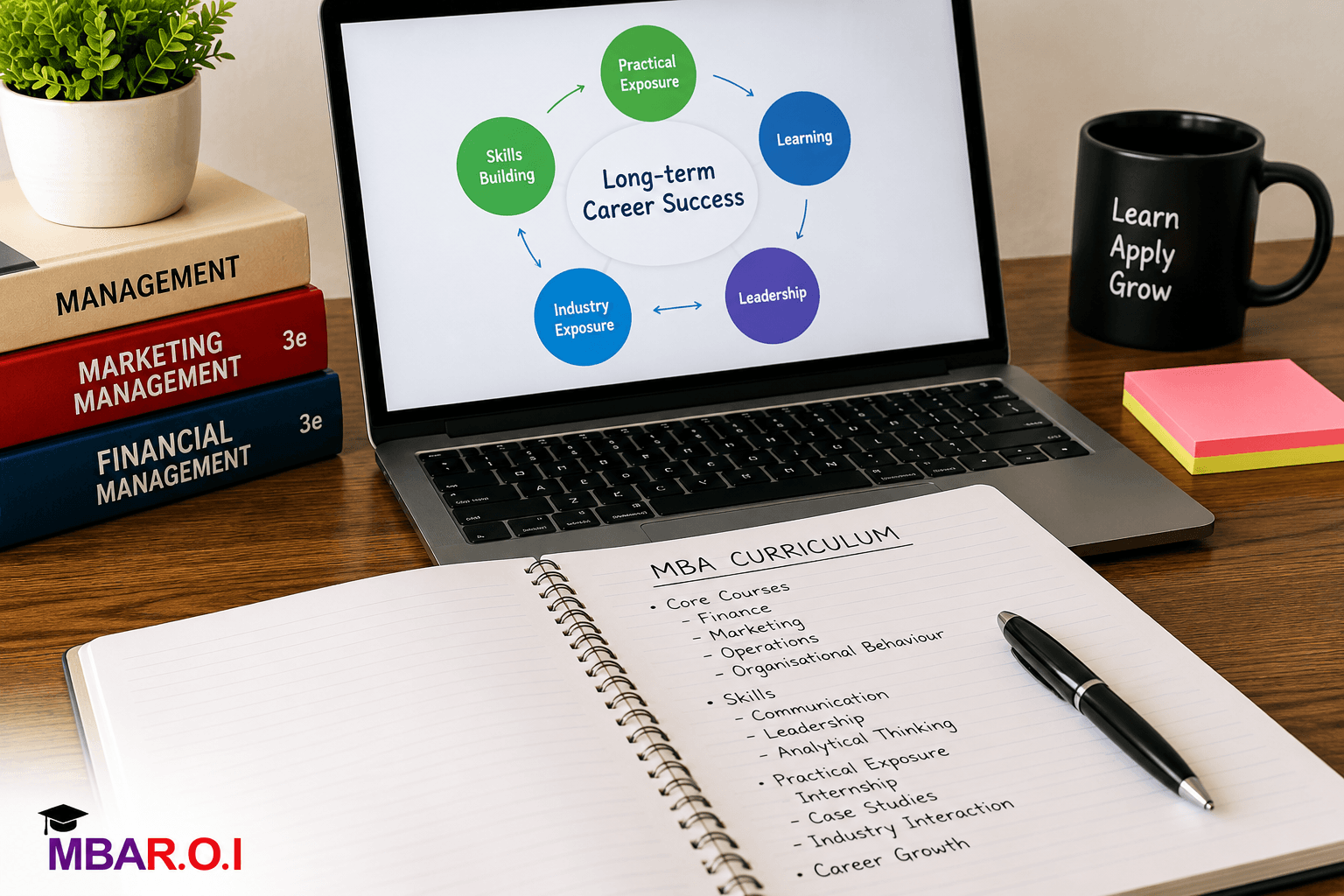
More than placements, the right MBA curriculum is what matters. A strong management curriculum will make students future-ready and industry-oriented and will help them to look beyond placement by securing their long-term career goals instead of getting initial placement from college.
MBA Colleges should not simply prepare students to get hired. It should prepare them to adapt, perform, lead and grow as the business environment changes.
Why Placements should be the Beginning, Not the End Goal
The first job is always important as it marks the transition from student to working professional. However, long-term career success depends on what happens after this first opportunity.
In this fast-changing world, industries evolve rapidly. Roles that were previously dependent on manual processes are now highly dependent on automation, analytics and artificial intelligence. GMAC data shows that the share of employers valuing AI-tool skills in hiring rose from 26% in 2024 to 31% in 2025.
Today’s management graduate needs practical and industry-oriented curriculum more than theoretical knowledge. They need the ability to learn continuously and apply their knowledge to unfamiliar business situations.
It is essential to understand that a job-ready graduate may be prepared for the first role, while a career-ready graduate is prepared for the journey ahead.
What students should look for in MBA curriculum to be future ready:
- Strong Business Fundamentals -
An organization works in a dynamic environment with different functions operating together. Every future manager needs to have strong fundamentals in order to work in a cross functional environment.
Finance, marketing, human resource, operations, economics, strategy and organizational behaviour are interconnected. A marketing decision can affect revenue. An operational decision can affect customer satisfaction. A person's decision can hamper productivity.
A strong business curriculum will build a deeper understanding of business functions giving them expertise in all areas.
- Communication and Leadership skills
A brilliant idea will be a complete flop show if it is not communicated effectively by any professional. One of the most important skill sets that every management program should cover is communication and leadership skills. 61% of employers identify leadership and social influence as a core skill as per The World Economic Forum's Future of Jobs Report 2025.
An MBA professional is expected to have strong communication and leadership as they are required to present recommendations, negotiate with different stakeholders, manage and build teams, interact and influence decision makers.
These two skill sets are not an option but a compulsion in management education. Students must understand what practical exposures they will be getting to develop their communication and leadership capabilities.
- Industry exposure
Classroom learnings are limited to clearing exams and earning a degree. The corporate world does not operate like a classroom.
Industry exposure builds practical understanding of theories learned in classes. Industry interactions, internships, capstone projects, interaction with industry experts can help students to apply and verify the concepts learned in classrooms. This will also help them to understand workplace expectations and make more informed career decisions.
- Data and Analytical skills
Data is an important resource of every organization to work in today’s business environment, modern managers make decisions based on the analysis of data. As per The World Economic Forum's Future of Jobs Report 2025 it was also identified that 69% of Employers identify analytical thinking as a core skill.
An MBA professional is no longer the one who tells “What should be done?”, but the one who knows “What and Why should it be done based on data?”
Business analytics, statistics, data visualization, and modern AI tools can help managers understand and evaluate data to make more informed decisions. Hence, it is the requirement of the MBA curriculum to teach and build analytical skills of aspirants.
- Practical exposure
Learning by doing is the best method of studies as there is a huge difference between knowing and applying business concepts.
Case studies, simulations, capstone projects and practical internship assignments allow students to build real decision-making skills rather than just theoretical understanding.
For instance, instead of learning the principles of finance, students can analyze reports through financial modelling.
This type of experimental learning helps students develop skills that textbooks alone cannot provide. The confidence to deal with real-world ambiguity comes from practical exposure.
- Multiple Specialization
Modern careers demand adaptability which can never come from single specialization. Multiple specialization understanding gives in depth understanding of business understanding.
A marketing professional may need to understand analytics. A finance professional may need to work with technology. An HR professional may need to interpret people's data.
An ideal curriculum must balance functional expertise to create industry ready professionals.
- Entrepreneurial skills & Problem-Solving Mindset
Having an entrepreneurial skill is to get ready for any sort of working environment as it teaches to adapt to changes in the business environment and to take evaluated risks. This education is valuable even for the students who do not wish to start their own companies and be entrepreneurs.
It teaches students to identify opportunities, understand customer needs, work with uncertainty and create value. These professional skills are equally valued inside an established organization, where managers need to address and solve problems.
Curriculum Creates Long Term Impact
Placements are the beginning of a career whereas the curriculum offers long term success.
MBA curriculum can be viewed as a chain:
Business concepts
↓
Practical Exposure
↓
Professional skills
↓
Industry exposure
↓
Leadership
↓
Career Growth
A student understands management fundamentals and knows how to apply them and is better equipped for changing business environments.
A student who develops communication and leadership skills is capable of taking greater responsibility and being a successful professional.
Together these capabilities are needed for long-term career growth.
When students evaluate an MBA programme they must look beyond placements
They should ask:
What will I learn?
How will I apply what I learn?
Will I work on real business problems?
Will I develop analytical and digital skills?
Will I become a better communicator?
Will I get opportunities to work with industry?
Will the curriculum prepare me for changes in the business environment?
Will I graduate with capabilities that remain valuable beyond my first job?
These questions shift the focus from simply finding a job to building a career.
Taxila Business School Prepares Students Beyond Placements
According to GMAC's 2025 Corporate Recruiters Survey, 99% of global employers expressed confidence in business schools' ability to prepare graduates for success in their organisations. Taxila Business School’s PGDM curriculum is designed to go beyond traditional classroom learning and prepare students for the evolving demands of the business world. The programme combines strong foundations in areas such as Finance, Marketing, Economics, Human Resources, Operations, Leadership, Business Law and Entrepreneurship with Business Analytics, including tools such as Python and Power BI and AI-integrated learning.
Alongside academic knowledge, students are exposed to managerial communication, presentations, case studies, simulations, projects, internships and industry interactions, helping them connect concepts with real-world business situations. The PGDM+Business Analytics structure further allows students to build analytical capabilities alongside functional expertise, while entrepreneurship-focused learning introduces concepts such as business model design, Lean Startup methodology and customer discovery. Together, these elements aim to develop not just placement-ready graduates, but adaptable professionals equipped with the knowledge, skills and mindset required for long-term career growth.
From Getting a Job to building a Career
Receiving an offer letter is not the end of, MBA experience. It is beyond getting a first job as the real test starts later, when the students face real world responsibilities in a corporate environment where changing industry, unfamiliar problems and new opportunities are managed together.
The right MBA curriculum is designed to make students understand who they can become after they enter the workplace.
Placements can open the first door but the right curriculum can help professionals keep opening new doors throughout their careers.
Frequently Asked Questions
Q1: What should a good MBA curriculum include?
Ans: Strong business fundamentals, data/analytics tools (like Python and Power BI), communication, industry exposure, and an entrepreneurial mindset.
Q2: Do placements matter more than curriculum when choosing an MBA college?
Ans: Placements matter for your first job, but curriculum matters for long-term growth — it builds the skills that keep you relevant for years.